


20.10.2026: Enrico BOCCATO (Univ. of Trieste): When swimming means more sex: the role of flagellate cells in the lichenized microalga Trebouxia, HS 31.11, Institut für Biologie, Bereich Pflanzenwissenschaften, Schubertstraße 51, 17:00 Uhr
Lichens are among the most successful symbioses on Earth. A fungus and a photosynthetic partner together colonise habitats where neither could survive alone. The green microalga Trebouxia is the partner in roughly half of all lichens. Yet its life cycle remains poorly known, and its swimming flagellate cells have long been regarded as purely asexual zoospores. However, this motile stage has much more to tell.
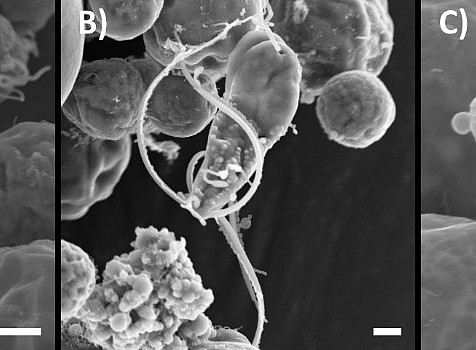
Combining continuous light-microscopy imaging with scanning electron microscopy, we found two distinct flagellate cell types in four Trebouxia species. Only elongated cells fused in pairs, forming zygotes whose development is consistent with meiosis. Key meiotic genes are present and expressed, supporting an active sexual cycle in a genus long thought to be asexual.
But what makes Trebouxia swim? Flagellate cell production is not triggered by a single cue. Instead, it is regulated by several environmental factors acting together, including nutrients, temperature, osmotic conditions and light quality.
Finally, these cells may matter for the symbiosis itself. Some lichen fungi, such as the common orange lichen Xanthoria parietina, disperse only through sexual spores and must find a suitable alga anew at every generation. We showed that Trebouxia flagellate cells actively swim towards germinating fungal spores. This response is not partner-specific but driven by nutrient-related signals, and it could nonetheless help bring future partners together.